
Orbit before the Moon: Gagarin’s Sturmanskie
We know the watch that went to the Moon. But what about the wristwatch that accompanied the first human spaceflight? The story of Sturmanskie, from military pilots to orbit and on to a museum display.
Once Around the Earth
The full film about Gagarin’s Sturmanskie. Presented in 16:9, with Turkish narration and Turkish and English subtitle options.
SK-1 suit reference: Nijuuf / Wikimedia Commons · CC BY 3.0 · adapted into an illustration.
Let’s turn the calendar back
Put space and watches in the same sentence and our minds tend to jump straight to the Moon. A bootprint, a white suit, a chronograph strapped over a sleeve. But what if we rewind the film by eight years? This time, the aim is to become the first person to leave Earth and return, before anyone has walked on another world.
On 12 April 1961, Yuri Gagarin became the first human to travel into space and orbit Earth aboard Vostok 1. A Sturmanskie accompanied him. Let’s be precise about its place in history: the first wristwatch to travel into space with a human. That is a narrower claim than the first timekeeping device of any kind sent into space, which would also encompass onboard clocks and uncrewed experiments.
That distinction takes nothing away from the story. It places the watch where it belongs: alongside a person making a journey no human had made before. The beginning is remarkable enough without inventing an extra act of heroism for the watch.
It had a job before it went to space
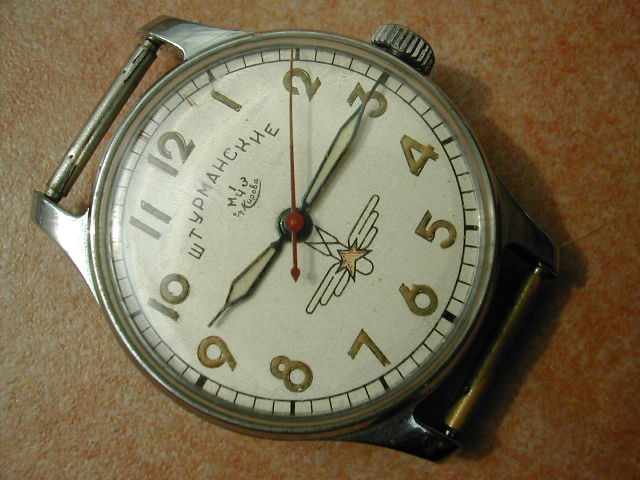
The Cosmonaut Training Center dates Sturmanskie production to 1949 at the First Moscow Watch Factory, for military aviation. The watches were issued to pilots joining their units and were not sold to the public.
That starting point changes how we look at the watch. In a shop window today, we might first notice the dial colour, the shape of the hands or how the case would sit on our wrist. For a pilot’s watch, the first question is simpler: what time is it, and does the person we are working with have the same time?
Sturmanskie’s own technical history highlights the ability to stop the seconds hand and synchronise watches. Picture that small action: stopping the hand, waiting for the agreed moment, then starting it again. A feature that watch enthusiasts now enjoy as a mechanical refinement was answering an everyday operational need.
One name, more than one watch
The difficult part of a vintage watch story sometimes begins just behind the dial. The same name can appear on watches made in different years, while photographs, commemorative models and older parts can become muddled together. A model’s connection with space does not mean that every example in front of us shares the same history.
In a 2021 article, the manufacturer associates Gagarin’s watch with the version it calls “Type II”; the same article explains that this was not an official model name. That is the manufacturer’s historical identification. We should not turn it into a definitive calibre or jewel count as though we had independently inspected the movement of the watch carried on the flight.
For a collector, this is where the interesting questions begin. Which period does each part belong to? Do the dial, hands, case and movement tell the same story? The word “Gagarin” in a sales listing should be the first line of an investigation, not the last.
A gift after the flight
The watch’s journey home has a human sequel. The Cosmonaut Training Center identifies its museum watch as one Gagarin carried on the flight. Its account says he gave it to Air Force Commander Konstantin Vershinin in April 1961; Vershinin’s daughter Elena later donated it to the museum.
A tool, a keepsake, then a museum object. We can look at the same dial in three different ways. First there is a time to read; then a personal gift from one person to another; finally, a piece of history others can see. Perhaps that is one reason vintage watches draw us in: while the mechanism measures time, the object gathers traces of people’s lives.
Why do we keep talking about the watch that went to the Moon?
It is easy to say “nobody knows about it”, but we have no research measuring that. We can, however, look at our own conversations about watches and ask a question: is the importance of a historical event the same thing as how often its story is told?
OMEGA’s celebration of the 60th anniversary of NASA qualification in 2025 offers a concrete example of how space heritage is presented today. Sturmanskie also keeps Gagarin’s name alive in its current collections. In our view, encountering a story repeatedly can make it easier to remember. That is an editorial observation, not a measured explanation of the two brands’ relative recognition.
And telling one story need not diminish the other. The watch that accompanied a person onto the lunar surface and the watch that accompanied the first human orbital flight belong to different pages of the same long history. Part of the pleasure of watches is turning those pages.
Looking at the dial today
We need to distinguish between the Gagarin commemorative watches sold today, an older Sturmanskie example and the object the museum identifies as a flown watch. A current Heritage model can refer to that past; it cannot become the particular object that was there.
But a watch need not have travelled into space itself for us to love it. Sometimes a dial takes us to a period we want to explore; a hand makes us notice a practical need we had never considered. Sturmanskie’s story reminds us of that. While looking towards the Moon, let’s not overlook that first journey around Earth.
Sources & further reading
This article was prepared for 1010 WatchClub using the sources below.
- NASA — Yuri Gagarin and the first human spaceflight
- Gagarin Cosmonaut Training Center — The museum’s flown watch and its provenance, 12 April 2021
- Sturmanskie — The manufacturer’s history of Gagarin’s watch and Type II, 6 September 2021
- OMEGA — 60 years since NASA qualification, 2025
- Sturmanskie — Gagarin and current commemorative collections